Word Vignette

Truth
Truth is one of those words we think we already understand, but if you listen long enough, the syllable deepens. It creaks like old timber, reveals rings of meaning that reach back to oaths, to covenant, to the sturdy patience of trees, and a life proved steady over time.
Etymology & Evolution
Truth stands as one of language’s most enduring concepts, evoking ideas of faithfulness, accuracy, and alignment with reality. The journey begins before Christ with the Proto-Indo-European (PIE) speakers, whose root deru- captured the unyielding strength of oaks or timber and the symbols of reliability in oral cultures. The word meant “firm, solid, steadfast,” with a specialized sense of “wood, tree.” Gina Cooke said it was associated with the “uprightness of an oak, the steadiness of a silver birch, and the fidelity of an orchard bearing fruit year after year.” With trees being the oldest living organism on earth, it is not surprising that the words, tree and truth, share a common origin.
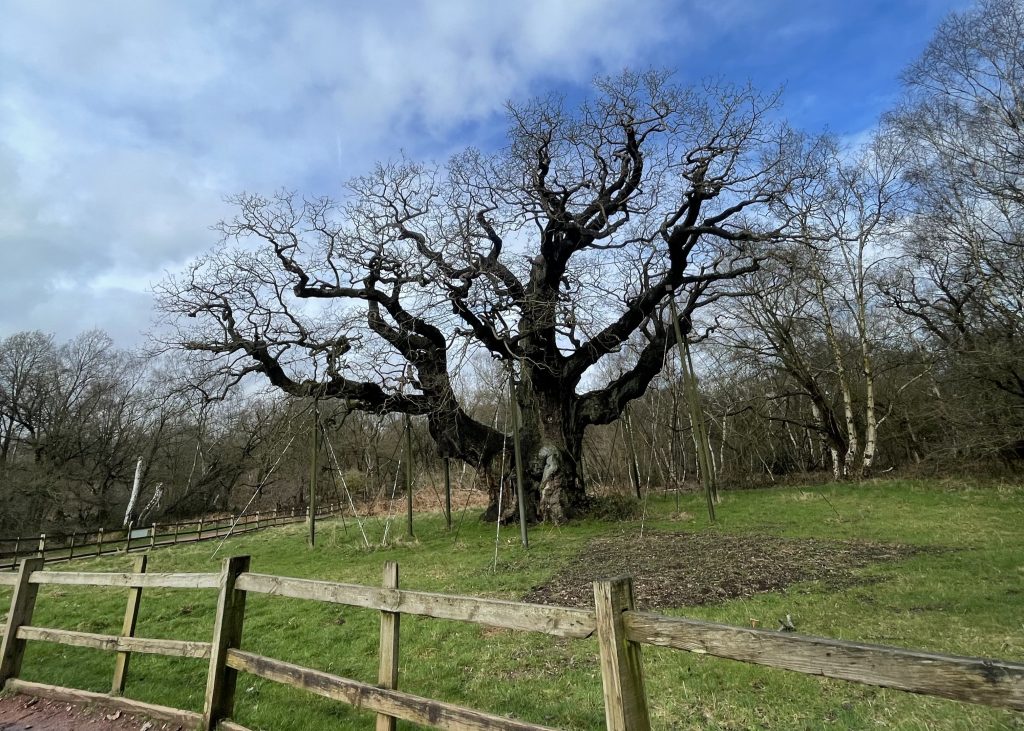
As the Into-European languages evolved, the word split into concrete and abstract branches with one yielding tree and the other truth. That is all except for English. During the time of Old English, it surfaces as trēow (TREE-oh-wah) and is used interchangeably for tree and truth, as in good faith, pledge, or promise. Here are two examples where this same word points to either a literal standing tree or a person’s inner steadfastness. King Alfred’s Old English translation of Augustine’s Soliloquies, uses the plural form of trēow in the following line —
Old English:
“Ġef ðē þurh trēowa findon þā ðe þē findon, sile mē þā trēowa.”
Modern English:
“If it is by faith that they find Thee who do find Thee, give me that faith.”
And this is a poetic example using trēow from the Rune Poem in the stanza on the yew tree:
Old English
Eoh byþ utan unsmeþe treow,
heard hrusan fæst, hyrde fyres,
wyrtrumun underwrepyd, wyn on eple.
Modern English:
"Yew is an unsmooth tree,
hard, earthfast, fire’s keeper,
underpinned with roots, a joy in the homeland."
Listen in Old English here: Yew
The Shift in Meaning
As the language moved toward Middle English, branches of the word continued to develop a more abstract definition. By the 14th century, truth broadened to “something true, a true statement,” then by the 1560s, “accuracy, conformity with fact.” Webster’s 1828 dictionary expands the definition to include, “the duty of a court of justice is to discover the truth.” But the legacy of that ancient root is still there. Truth is solid, it nourishes, is something to lean on, and those who speak it are reliable and steadfast just as an oak.
Cultural Echoes
Throughout history, poets, philosophers, and people in search for the truth often look to the trees. Pablo Neruda asked, “What did the tree learn from the earth to be able to talk with the sky?” Herman Hesse had a profound, almost mystical reverence for trees and wrote in Bäume (1915), “whoever knows how to speak to them, whoever knows how to listen to them, can learn the truth.” Jesus said in John 14:6, “I am the way, the truth, and the life.”
Today, we live in an age where headlines flash and vanish in a blink, where mass media offers more information than a single life can hold, it can be hard to tell fact from fiction, signal from noise. But, if you follow this word back through the centuries, you will discover that truth is less about winning an argument and more about what holds fast when the seasons change.
Sources and Further Reading:
- Alpha Dictionary. Truth. https://www.alphadictionary.com/goodword/word/truth
- Etymonline. Truth. https://www.etymonline.com/word/truth
- Etymology: The Truth in Trees – Headwaters Magazine https://www.headwatersmagazine.com/blog-1-1/etymology-the-truth-in-trees
- Gina Goode. The Story of True. https://www.youtube.com/watch?v=VYFE3tYUdJU
- Herman Hesse. Bäume. Trees are Sanctuaries, by Herman Hessehttps://www.awakin.org/v2/read/view.php?tid=2170&sso_checked=1
- Pablo Neruda. The Poetry Foundation. https://www.poetryfoundation.org/articles/90420/questions-we-didnt-know-we-wanted-to-ask?query=pablo
- Tha Engliscan Gesithas. The Anglo-Saxon Rune Poem. https://www.tha-engliscan-gesithas.org.uk/written-and-spoken-old-english/old-english-alphabet-2/the-anglo-saxon-rune-poem/
- True as Trees – edge of legible – WordPress.com https://edgeoflegible.wordpress.com/2014/07/15/true-as-trees/
- Truth & reliability: an etymology – Reddit https://www.reddit.com/r/etymology/comments/1cfk52s/truth_reliability_an_etymology/
- Truth of Trees (Part 1) – Rainbow Juice https://www.rainbowjuice.org/2022/01/truth-of-trees-part-1.html
- Truth, Sturdy Tree – A Druid Way https://adruidway.com/2017/02/25/truth-sturdy-tree/
A fascinating story of truth:
Like a tree’s faithful roots holding fast through storms, how has truth stayed steady in your life?